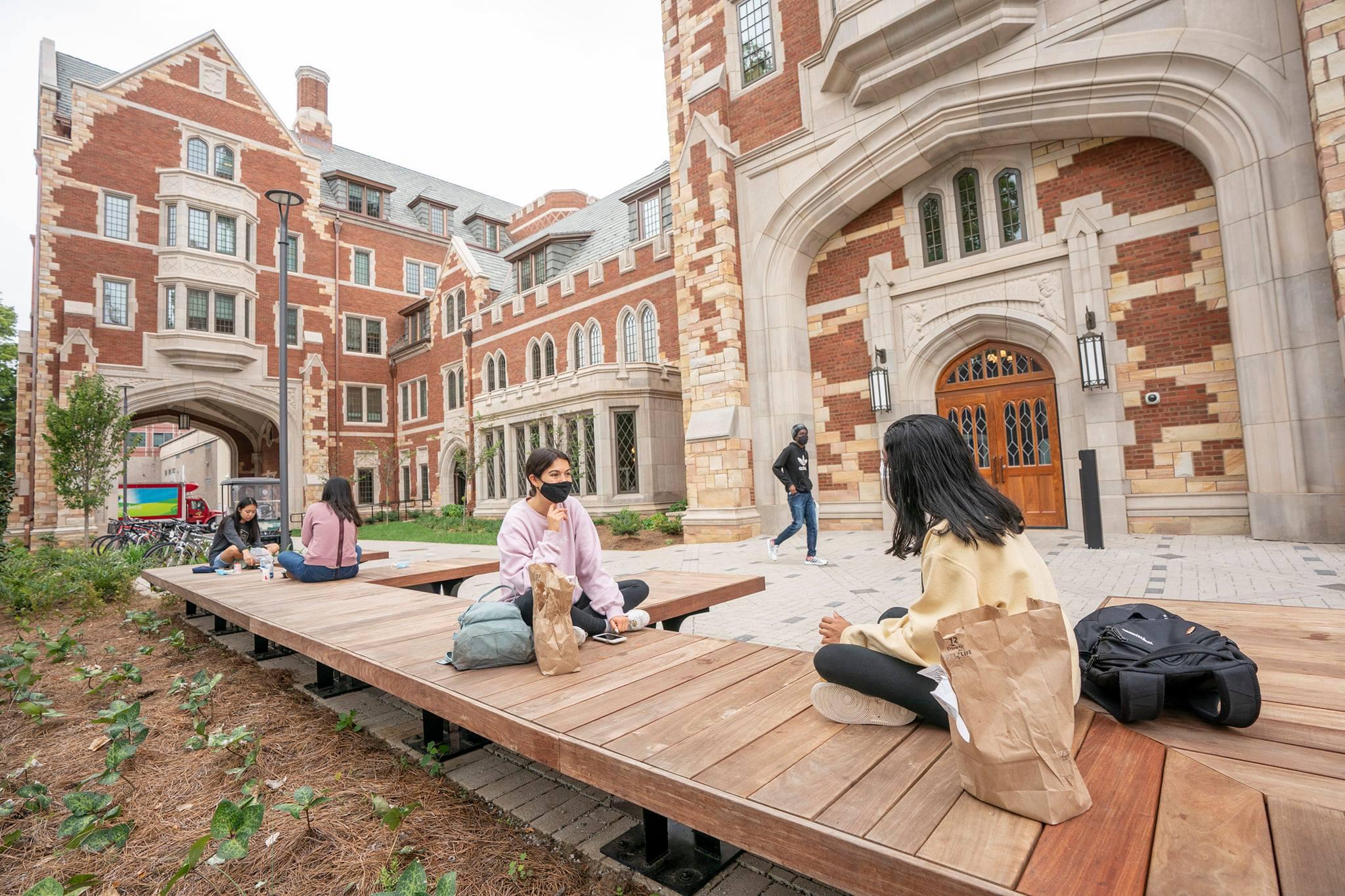
Vanderbilt University is a distinguished private research university in Nashville, Tennessee, known for combining rigorous academics, groundbreaking research, interdisciplinary learning, and a vibrant campus community. Since its founding in 1873, Vanderbilt has developed from a regional institution into a globally connected university whose students and faculty work across science, medicine, engineering, education, business, the humanities, and the arts.
What makes Vanderbilt particularly interesting is the way its academic identity intersects with its location. Nashville is widely recognized for music and entertainment, but it is also a growing center for healthcare, technology, entrepreneurship, education, and business. Vanderbilt’s campus sits within this dynamic environment, giving students opportunities to connect classroom learning with a rapidly changing world. 🌎


10
For students considering higher education, Vanderbilt offers an environment where intellectual curiosity is encouraged alongside collaboration, creativity, and personal development. Its undergraduate and graduate programs cover a broad spectrum of disciplines, while its research enterprise addresses complex questions affecting communities locally and globally.
🏛️ A University Built Around Discovery and Opportunity
Vanderbilt University was founded in 1873 with a vision of creating an institution that would contribute to education and intellectual development in the American South. The university was named after Cornelius Vanderbilt, whose endowment supported the establishment of the institution.
Over the decades, Vanderbilt expanded its academic programs and research activities, eventually becoming a major research university with a strong national and international presence.
The university’s evolution reflects changes in higher education itself.
Universities today are expected to do more than provide classroom instruction. They are places where new knowledge is created, technologies are developed, communities are served, and future leaders are prepared.
Vanderbilt’s academic structure reflects this broad mission.
Students can explore subjects ranging from political science and history to biomedical engineering, computer science, neuroscience, education, economics, music, mathematics, medicine, law, and business.
This diversity creates opportunities for students to move beyond narrow academic categories.
A student interested in artificial intelligence, for example, might study computer science while exploring ethics, psychology, business, or human behavior. A student interested in healthcare could combine biological sciences with engineering, public policy, or data analysis.
Such connections are increasingly important because the world’s most significant challenges rarely belong to one discipline.
Climate change involves science, economics, politics, engineering, and communication.
Healthcare involves biology, medicine, technology, psychology, public policy, and economics.
Artificial intelligence involves mathematics, computer science, ethics, law, business, and social science.
Vanderbilt’s interdisciplinary culture provides an environment in which these connections can become part of the learning experience. 💡
🎓 Academic Excellence Across Disciplines
Vanderbilt is organized into several undergraduate and graduate schools and colleges, each offering specialized areas of study while remaining part of a larger academic community.
The College of Arts and Science provides a broad liberal arts foundation. The Blair School of Music supports musicians and scholars interested in performance and musical study. The School of Engineering focuses on technology, innovation, and problem-solving. The Peabody College of education and human development has developed a strong reputation for research and professional preparation.
Other major areas include law, medicine, nursing, management, and graduate-level research.


This academic variety can be particularly valuable for students who are still discovering their interests.
Choosing a university does not necessarily mean knowing exactly what career you want at age eighteen.
Students often change their academic direction after encountering new subjects.
Someone may begin university thinking they want to study biology and discover an interest in computational research. Another student may start in economics and become fascinated by public policy. A future engineer may discover a passion for entrepreneurship.
A broad university environment can make these transitions easier.
Vanderbilt’s curriculum allows students to build specialized knowledge while also encountering subjects outside their primary area.
This combination can create a balanced education.
Specialization helps students develop expertise.
Breadth helps them understand context.
Both are valuable.
🔬 Research at Vanderbilt
Research is one of the most important components of Vanderbilt University’s identity.
As a major research institution, Vanderbilt supports investigations across numerous fields, including medicine, biological science, engineering, neuroscience, education, social science, public policy, and the humanities.
Research transforms students from passive recipients of information into active participants in discovery.
In a conventional lecture, students may learn what researchers already know.
In a research environment, students can ask what researchers do not yet know.
That difference is significant.
A research question might begin with a simple observation.
Why does a particular biological process occur?
How can a machine-learning model become more reliable?
What factors influence student learning?
How do communities respond to public policy?
What materials could improve a technological device?
Why do certain economic patterns emerge?
Answering these questions requires patience, evidence, creativity, and critical thinking.


Students who participate in research can develop skills in experimental design, data analysis, writing, communication, teamwork, and problem-solving.
They also learn an important lesson about uncertainty.
Research does not always produce the expected result.
A hypothesis may be wrong.
An experiment may fail.
A dataset may reveal an unexpected pattern.
A project may need to be redesigned.
Rather than viewing these experiences as simple failures, researchers can treat them as information that guides the next step.
This mindset is useful far beyond laboratories.
It teaches students how to approach difficult problems without expecting immediate answers.
🧬 Medicine, Health, and Human Well-Being
Vanderbilt has a particularly strong presence in healthcare and biomedical research.
Vanderbilt University Medical Center and the Vanderbilt University School of Medicine contribute to an extensive ecosystem involving clinical care, medical education, and scientific investigation.
This environment creates opportunities for connections among medicine, technology, biology, data science, nursing, public health, and other fields.
Modern healthcare increasingly depends on collaboration.
A physician may work with geneticists, data scientists, engineers, nurses, psychologists, pharmacists, and public health specialists.
Medical innovation can involve artificial intelligence, advanced imaging, genomics, medical devices, digital health technologies, and new approaches to treatment.


Vanderbilt’s academic ecosystem allows students and researchers to encounter this multidisciplinary approach.
The relationship between medicine and technology is particularly important.
For example, machine learning can help researchers analyze complex datasets. Engineering can contribute to medical devices. Data science can support healthcare decision-making. Behavioral science can help researchers understand how patients interact with treatment.
Healthcare therefore becomes more than a medical subject.
It becomes a multidisciplinary challenge involving science, technology, society, ethics, and human behavior.
This approach can encourage students to think about the patient as a whole person rather than simply as a medical problem.
💻 Engineering, Technology, and Innovation
The Vanderbilt School of Engineering provides another important dimension of the university.
Engineering education is increasingly connected to interdisciplinary problem-solving.
Today’s engineers work in areas such as robotics, biomedical technology, artificial intelligence, cybersecurity, energy, materials science, transportation, and advanced manufacturing.
These fields require technical knowledge, but technical knowledge alone is not always enough.
Engineers also need to understand users, organizations, communities, and ethical considerations.
A technically impressive product can still fail if it does not solve a meaningful problem.
Vanderbilt’s engineering environment encourages students to consider both technical and human dimensions.


Imagine a team designing a medical device.
Engineers may focus on the hardware.
Computer scientists may develop the software.
Medical researchers may explain clinical requirements.
Designers may consider usability.
Business specialists may examine cost and distribution.
Ethicists may consider questions of access and responsibility.
A successful solution may require all of these perspectives.
This is why interdisciplinary education has become so important.
Innovation rarely occurs in isolation.
It often happens when people with different skills come together around a shared problem. 🤝
📚 Education and Human Development
Vanderbilt’s Peabody College has a long-standing focus on education and human development.
Education is a field that reaches far beyond traditional classroom teaching.
It involves psychology, sociology, technology, public policy, neuroscience, economics, communication, and human development.
Researchers and educators study questions such as:
How do children learn?
What teaching strategies improve student outcomes?
How can schools become more inclusive?
How does technology influence education?
What factors affect educational opportunity?
How can teachers support students with different needs?
These questions have consequences for entire societies.
Education influences workforce development, economic mobility, civic participation, innovation, and quality of life.


Students interested in education can therefore explore a field with broad social impact.
The combination of research and practical application is particularly valuable.
Research can identify patterns.
Practice can test solutions.
Policy can determine how solutions are implemented.
Communities can provide feedback about what works and what does not.
This cycle can help improve education over time.
🎵 Music, Creativity, and the Arts
Vanderbilt’s location in Nashville gives its creative and musical programs an especially interesting cultural context.
Nashville is internationally associated with music, but its artistic ecosystem extends into numerous genres and creative industries.
The Blair School of Music contributes to Vanderbilt’s academic environment through performance, music education, composition, scholarship, and other forms of musical study.


The arts are valuable not only for students planning artistic careers.
Creative thinking can support almost every discipline.
Scientists need imagination when developing hypotheses.
Engineers need creativity when designing solutions.
Entrepreneurs need original ideas.
Teachers need engaging ways to communicate.
Business professionals need to understand audiences.
Researchers need to consider alternative explanations.
The arts can therefore contribute to a broader culture of experimentation.
Music, theater, visual arts, writing, and other creative disciplines encourage people to see familiar subjects from new perspectives.
That ability to shift perspective is a powerful intellectual skill.
🌳 A Campus Designed for Community
The physical campus is another important part of the Vanderbilt experience.
Located in Nashville, Vanderbilt’s campus combines historic buildings, modern facilities, green spaces, residential areas, academic centers, and spaces for student activities.

A university campus is more than a collection of classrooms.
It is where students build relationships, exchange ideas, participate in organizations, relax between classes, attend events, and develop a sense of belonging.
Campus design can influence these interactions.
A green space can become a place for informal conversations.
A library can become a collaborative study environment.
A student center can bring people together around shared interests.
A residence hall can introduce students to people from different cultures and backgrounds.
These everyday interactions can become an important part of university education.
Learning does not stop when class ends.
Sometimes the most meaningful conversations happen while walking across campus, eating with friends, participating in a club, or working on a group project.
🤝 Student Organizations and Leadership
University life also provides opportunities to develop leadership.
Students can participate in academic organizations, cultural groups, volunteer activities, entrepreneurship programs, publications, performance groups, athletics, and professional societies.
Each activity can teach different skills.
A student organization leader learns how to coordinate people and manage responsibilities.
A volunteer learns how to work with communities.
A student journalist develops communication skills.
An entrepreneur learns how to transform an idea into a project.
An athlete learns about teamwork, discipline, and persistence.


These experiences can complement academic learning.
Employers and graduate programs often value applicants who can demonstrate initiative and collaboration.
More importantly, leadership experiences can help students understand their own strengths.
Someone who initially avoids public speaking may discover confidence after leading a student organization.
Someone who prefers working independently may discover the value of teamwork.
Someone who thinks leadership means giving instructions may learn that effective leadership often involves listening.
These lessons can remain useful long after graduation.
🌎 A Diverse and Connected Community
Universities bring together people from different backgrounds, cultures, regions, and academic interests.
Vanderbilt’s community reflects this diversity.
Students have opportunities to interact with people whose experiences may differ significantly from their own.
This can expand perspectives.
A conversation with a classmate from another country can introduce a new understanding of an international issue.
A group project involving students from different academic disciplines can reveal alternative approaches to the same problem.
A cultural organization can provide opportunities to learn about traditions and experiences unfamiliar to other students.
Diversity therefore becomes an educational resource.
It encourages people to reconsider assumptions.
It can also improve collaboration because students learn how to communicate with people who approach problems differently.
🌍 In a global economy, these skills are increasingly valuable.
🏙️ Nashville as an Educational Advantage
Vanderbilt’s location in Nashville is one of its most distinctive features.
Nashville has developed into a major center for music, healthcare, education, entrepreneurship, and business.
This creates an unusual combination.
Students can experience a university environment while also having access to a growing metropolitan economy.
For students interested in music, Nashville provides obvious advantages.
For students interested in healthcare, the city offers connections to a substantial medical ecosystem.
Entrepreneurship students can explore a growing startup community.
Business students can observe companies operating across multiple industries.
Education students can engage with schools and community organizations.


7
The city can therefore function as an extension of the classroom.
A student studying urban development can examine Nashville’s growth.
Someone studying economics can observe changing industries.
A communication student can explore the relationship between music, media, and technology.
A public policy student can consider the challenges created by population growth.
This connection between campus and city can help students understand how academic concepts operate in real communities.
🧠 Critical Thinking in the Digital Age
Modern students have access to more information than previous generations could have imagined.
A smartphone can provide access to articles, databases, videos, research papers, social media posts, and artificial intelligence tools within seconds.
But access to information does not automatically create knowledge.
Students need to evaluate sources.
They need to identify misinformation.
They need to understand research methods.
They need to distinguish evidence from opinion.
They need to recognize when a statistic is misleading.
Universities have an important role in developing these abilities.
Vanderbilt’s research-centered environment can encourage students to approach information critically.
Instead of accepting a claim simply because it appears online, students can learn to ask:
Who produced this information?
What evidence supports it?
How was the evidence collected?
Could another explanation exist?
What limitations should be considered?
These questions are increasingly important in a digital society.
Artificial intelligence makes them even more relevant.
AI systems can produce convincing text, images, and explanations, but users still need to evaluate accuracy and context.
The future therefore requires people who can combine technology with judgment.
💡 Entrepreneurship and New Ideas
Innovation does not always begin inside a traditional laboratory.
It can begin with identifying an everyday problem.
A student might notice that a process is inefficient.
A researcher might discover a promising technology.
A community member might identify an unmet need.
An entrepreneur can then attempt to create a solution.
Vanderbilt’s academic environment can support this type of thinking by bringing together students from different disciplines.
Business knowledge can combine with engineering.
Medical research can combine with entrepreneurship.
Computer science can combine with design.
Education can combine with technology.
This cross-pollination can create opportunities for new ideas.
Entrepreneurship also teaches resilience.
Not every idea succeeds.
A product may need to change.
A business model may not work.
Customers may respond differently than expected.
A team may encounter unexpected challenges.
Learning how to adapt is often as important as the original idea.
🚀 Innovation is therefore not simply about having a brilliant idea. It is about testing, learning, improving, and trying again.
🌱 Service and Social Impact
Higher education also has a responsibility to society.
Universities produce knowledge, but knowledge becomes more meaningful when it can contribute to communities.
Students can participate in volunteer activities, community engagement, research projects, education initiatives, healthcare programs, and other forms of service.
Social impact can take many forms.
A student may tutor local children.
A researcher may investigate a public health challenge.
An engineer may develop an accessibility solution.
A business student may support a nonprofit organization.
A journalist may tell stories that help communities understand important issues.
These activities can teach students that professional success and social responsibility do not have to be separate.
A career can be both personally meaningful and socially useful.
That perspective can influence how students think about their future.
🌟 Preparing for an Uncertain Future
One of the greatest challenges facing modern universities is preparing students for careers that may not yet exist.
Technology continues to transform industries.
Artificial intelligence is changing professional workflows.
Automation is affecting manufacturing and business.
Biotechnology is creating new possibilities in healthcare.
Climate challenges are generating demand for new energy and environmental solutions.
Digital communication is changing how organizations interact with audiences.
Students therefore need more than technical knowledge.
They need adaptability.
They need communication skills.
They need creativity.
They need analytical thinking.
They need the confidence to learn unfamiliar subjects.
Vanderbilt’s combination of liberal arts, professional education, scientific research, technology, medicine, business, and the arts can provide students with multiple ways to develop these capabilities.
A student can become a specialist without becoming intellectually narrow.
That balance is increasingly valuable.
🎯 Why Vanderbilt Can Be an Inspiring Academic Environment
Choosing a university is a deeply personal decision.
Students consider academics, research, campus culture, location, financial factors, career opportunities, community, and personal fit.
Vanderbilt offers a distinctive combination of these elements.
Its research culture provides opportunities for discovery.
Its academic schools offer breadth and specialization.
Its Nashville location connects students with a dynamic city.
Its campus provides a strong residential environment.
Its interdisciplinary approach encourages connections between subjects.
Its student organizations create opportunities for leadership and community.
Its professional and research networks can help students explore possible careers.
But perhaps the most important feature is the culture of curiosity.
A university becomes memorable when students are encouraged to ask questions.
What if there is a better solution?
Why does this happen?
How can this process be improved?
What evidence supports this conclusion?
How can this idea help someone?
These questions create the foundation for meaningful learning.
🔮 Vanderbilt and the Future of Higher Education
The future of higher education will likely involve greater collaboration between universities, industries, governments, communities, and technology organizations.
Vanderbilt is positioned within a city that is itself experiencing significant growth and transformation.
This environment creates opportunities for students and researchers to engage with emerging challenges.
Artificial intelligence may transform education and healthcare.
Advanced biomedical research may change medical treatment.
Data science may influence public policy.
New communication technologies may reshape media.
Entrepreneurship may create new industries.
Climate challenges may require innovative engineering and policy solutions.
No single discipline will be able to address these questions alone.
The universities of the future will need to create environments where specialists can communicate effectively with one another.
That means engineers need to understand human needs.
Scientists need to communicate with policymakers.
Business leaders need to understand technology.
Technology developers need to consider ethics.
Educators need to understand emerging tools.
Vanderbilt’s multidisciplinary academic structure provides a strong foundation for this kind of collaboration.
💜 Conclusion: A Place for Curiosity, Collaboration, and Growth
Vanderbilt University represents a distinctive approach to higher education—one that brings together academic excellence, research, creativity, professional preparation, community, and innovation.
Its Nashville location adds another important dimension. Students can experience a university campus while remaining connected to a city known for music, healthcare, business, education, and entrepreneurship.
Across its academic programs, Vanderbilt encourages students to explore ideas deeply while making connections across disciplines.
🔬 Researchers investigate unanswered questions.
🎓 Students develop specialized knowledge.
💡 Entrepreneurs explore new solutions.
🎵 Artists create and perform.
💻 Engineers design technologies.
📚 Educators investigate how people learn.
🧬 Medical researchers explore new approaches to human health.
🌎 Students develop perspectives that can prepare them for an interconnected world.
The value of a Vanderbilt education ultimately extends beyond a classroom or degree.
It can provide students with the intellectual tools to ask better questions, evaluate evidence, collaborate with others, communicate ideas, and adapt to changing circumstances.
In a world where knowledge continues to expand at extraordinary speed, these abilities are increasingly important.
A successful university should not simply prepare students for the world as it exists today. It should help them develop the curiosity and confidence to participate in shaping tomorrow.