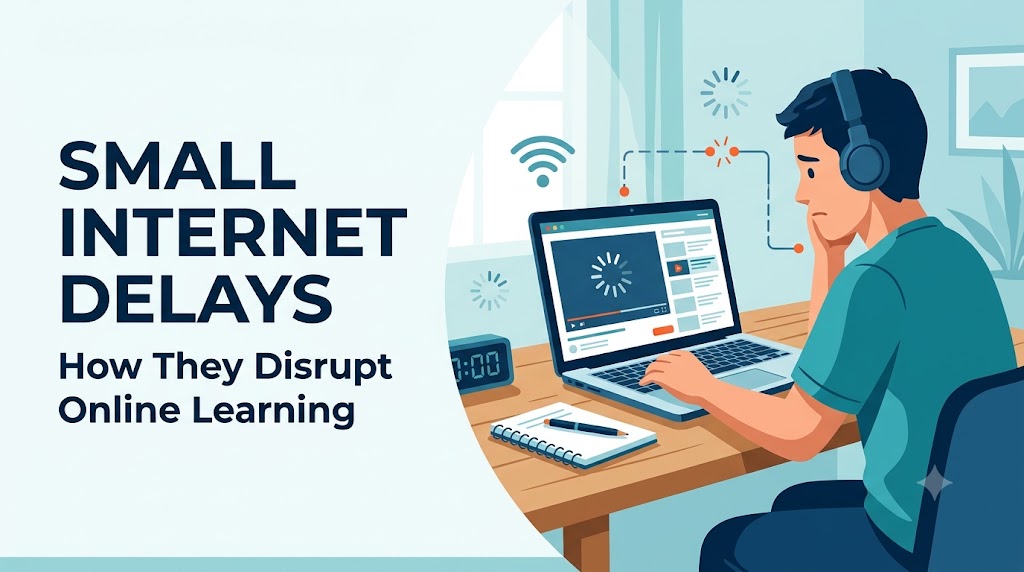
Why slow-loading lessons, unstable internet connections, and digital interruptions can affect student concentration, motivation, and academic performance.
Category: Online Learning · Educational Technology
In today’s digital world, online learning has become an important part of education. Students attend virtual classes, watch recorded lectures, complete online assignments, and use educational platforms to develop new skills. Although these tools make education more accessible, their effectiveness often depends on something students may take for granted: a reliable internet connection.
A video that takes several seconds to load, an audio interruption during an important explanation, or a virtual classroom that repeatedly disconnects may seem like a minor inconvenience. However, when these interruptions happen repeatedly, they can disrupt the learning process, increase frustration, and make it more difficult for students to understand and remember information.
The relationship between internet performance and education deserves attention because digital learning is not simply about providing students with access to content. It is also about ensuring that they can engage with that content without unnecessary interruptions.
Recent Research: Even One or Two Seconds Can Matter

A study published in Nature Human Behaviour on October 8, 2026, titled “Microdelays disrupt online learning,” examined how brief loading delays affect educational engagement and performance. Researchers analyzed learning data from 26,707 primary and secondary school students in the United States and 55,184 aspiring coders, primarily in Latin America.
The researchers found that loading delays as short as one or two seconds were associated with weaker engagement and poorer learning-related outcomes. Students completed fewer online mathematics assignments, took longer to finish their work, became more likely to get distracted, and achieved lower scores. The coding learners spent less time actively engaged, completed fewer lessons, and were less likely to reach an important course milestone.
A separate randomized experiment involving 598 adults offered further evidence. Participants who encountered three-second loading screens before reading pages were less likely to finish the reading task than those who experienced uninterrupted reading: approximately 54% versus 70%. This suggests that even short delays can reduce persistence. However, the results do not establish that every brief delay causes lasting educational harm.
These findings are important because they challenge the assumption that only major technical failures affect online education. A platform does not necessarily need to crash to interrupt learning. Small delays, repeated across many interactions, may gradually make students less willing or able to stay engaged.
Why Slow Internet Can Interrupt Concentration

The cost of switching attention
Learning requires sustained attention. When students work through a mathematics problem, listen to a teacher explain a scientific concept, or practise a new programming technique, they must keep relevant information in mind while connecting it to what they already know.
A loading delay interrupts this process. Students may stop reading, look at another browser tab, check their phones, or begin thinking about something unrelated. When the content finally appears, they must redirect their attention to the original task.
This process can create a recovery cost: time and mental effort are spent returning to the lesson rather than understanding it. Research published in Humanities and Social Sciences Communications in August 2026 also found that task interruptions in STEM online courses were associated with greater cognitive and emotional strain, which in turn affected learning outcomes and user experience.
Frustration and declining motivation
Repeated delays can make a learning platform feel unreliable. A student who encounters buffering during every video or waits for each quiz question to load may become frustrated, even when the subject itself is interesting.
That frustration can gradually reduce motivation. Students may shorten their study sessions, postpone assignments, or abandon a lesson before reaching the most valuable material.
This does not mean every student will react the same way. Some may patiently wait, while others may switch to a different resource. The recent research nevertheless suggests that the design and performance of digital learning platforms can influence whether learners persist.
Multitasking during loading periods
Waiting can encourage students to fill the gap with other activities. They may open social media, answer messages, or browse unrelated websites. Although these activities might occupy only a few seconds, returning to the lesson requires another shift in attention.
A 2025 systematic review of 26 studies on digital distractions in education identified technology-related distractions, personal needs, and instructional-environment factors as important sources of disrupted academic focus. The review also discussed how task switching and non-academic device use can interfere with learning.
The problem is not that students necessarily lack discipline. Poorly timed delays can create opportunities for distraction, particularly in self-directed learning environments where no teacher is present to guide students back to the task.
How Internet Delays May Affect Learning Outcomes

Lower assignment completion
Students who repeatedly encounter delays may complete fewer questions or leave an assignment unfinished. Even motivated learners can lose momentum when every next step requires waiting.

Reduced learning efficiency
Slow-loading pages and interrupted videos can extend the time needed to complete a lesson. Students may spend more time navigating the platform and less time practising, reviewing, or understanding the subject.

Difficulty following complex explanations
If a lecture repeatedly freezes while a teacher explains a formula, a diagram, or a sequence of steps, students may miss connections between ideas. Replaying the material can help, but it takes additional time and effort.

Unequal educational opportunities
Learners with unstable or slow connections may experience more interruptions than those with reliable broadband. This can make it harder to participate consistently, particularly when lessons depend on live video, interactive exercises, or timed assessments.
These are plausible pathways through which connectivity problems can affect education, but their effects vary by student, subject, platform, and learning activity. Importantly, the 2026 microdelay study measured outcomes such as assignment completion, scores, engagement, and lesson progress. It did not establish that short delays necessarily cause long-term memory loss or lower final grades.
The Digital Divide Is About More Than Internet Access

Discussions about digital inequality often focus on whether students have a smartphone, computer, or internet connection. However, access alone does not guarantee a smooth learning experience. The speed, stability, affordability, and reliability of that connection also matter.
Imagine two students enrolled in the same online course. One can open lessons instantly, participate in live discussions, and submit assignments without interruption. The other experiences frequent buffering, delayed quiz responses, and occasional disconnections. Although both students technically have access to the same educational resources, they may not have equally convenient opportunities to use them.
This difference is especially relevant in regions where students rely on mobile data, shared devices, or inconsistent household connectivity. In India, for example, a student’s online learning experience may depend on local network conditions, the quality of their device, and the number of people sharing a connection.
A further challenge is that slow connections can be mistaken for poor academic ability or a lack of motivation. A student who takes longer to complete a digital assignment might be struggling with the subject, dealing with technical delays, or experiencing both problems simultaneously.
Educational institutions should therefore distinguish between learning difficulties and technology-related barriers. Reliable access should be considered part of the learning environment rather than merely a technical convenience.
Why Online Learning Platforms Need Better Design

Educational technology developers can help reduce the impact of small delays by designing platforms that remain usable under different network conditions.
Make lessons lightweight
Large video files, complex animations, and unnecessary page elements can increase loading times. Developers can improve accessibility by compressing media, reducing unnecessary scripts, and loading only the content students need at that moment.
A mathematics exercise, for instance, should not require downloading a large collection of unrelated images before the student can answer a question.
Provide offline learning options
Students should be able to download lecture notes, worksheets, reading materials, and selected videos when connectivity is available. Offline access allows them to continue studying during temporary network failures.
For subjects that involve calculations or programming, platforms can also consider saving progress locally and synchronizing completed work when the connection returns.
Save progress automatically
Few experiences are more frustrating than losing completed work because a connection drops during submission. Automatic saving, clear confirmation messages, and safe retry mechanisms can reduce this risk.
Platforms should distinguish between an answer that has been saved and one that is still waiting to upload. This is particularly important for assignments with deadlines.
Adapt to connection quality
Streaming services often adjust video quality to maintain playback. Educational platforms can apply similar principles by offering lower-resolution video, audio-only lectures, text transcripts, and simpler versions of interactive activities.
The aim is not to provide every learner with an identical visual experience. It is to ensure that everyone can access the essential educational content.
Measure real user experience
Developers should monitor more than server availability. A platform may technically be online while individual students experience slow pages, delayed responses, or repeated loading failures.
Measuring page-load times, failed submissions, video buffering, and the time required to complete common learning tasks can help institutions identify problems that might otherwise remain invisible.
Practical Strategies for Students
Students cannot always control their internet service, but a few practical adjustments can make online learning more resilient.
Download materials in advance
Save reading materials, presentations, worksheets, and permitted recordings before a study session. This reduces the number of times you need to wait for content to load.
Choose the most stable connection available
If possible, study near the router, reduce unnecessary network use by other devices, or use a reliable alternative connection. A stable connection is often more useful for learning than a high advertised speed that fluctuates.
Reduce unrelated notifications
Silence non-essential notifications and keep unrelated tabs closed. This will not fix a slow network, but it can prevent a brief loading delay from turning into a longer distraction.
Keep notes and track your progress
Record key ideas in a notebook or local document. If a video freezes or the platform disconnects, you can resume more easily without losing the context of the lesson.
Use a recovery routine
When a delay occurs, avoid repeatedly clicking buttons that may submit the same answer multiple times. Check whether the content has loaded, confirm that work is saved, and return to the current question before continuing.
Students should also communicate recurring technical problems to their teachers or institutions. Where appropriate, educators can provide additional time, alternative submission methods, or downloadable resources rather than penalizing learners for circumstances beyond their control.
What Teachers and Educational Institutions Can Do
Teachers play an important role in making online learning less vulnerable to connectivity problems. A well-designed lesson should allow students to recover from interruptions without losing their understanding of the material.
For example, teachers can provide a short written summary alongside a recorded lecture. If a student misses part of a live session, the summary helps them identify the central concepts before reviewing the recording.
Assignments can also be divided into manageable sections, with progress saved after each step. This makes it easier for students to resume work after a disconnection rather than restarting an entire activity.
Institutions should consider offering asynchronous alternatives to activities that depend heavily on uninterrupted live participation. Recorded explanations, downloadable worksheets, flexible deadlines, and text-based discussion options can help learners with different connectivity conditions.
Teachers should also avoid interpreting every delay in participation as disengagement. A student whose camera is switched off or whose response arrives late may be experiencing network difficulties rather than a lack of interest.
Finally, schools and universities can evaluate their platforms using realistic connection conditions. Testing only on fast institutional networks may overlook the challenges faced by students studying from home or using mobile data.
What Researchers Still Need to Investigate
The 2026 research on microdelays provides important evidence that brief loading times are associated with reduced engagement and achievement. However, several questions remain.
First, researchers need to understand whether repeated short delays affect long-term knowledge retention, examination results, and course completion over months or years. Short-term assignment scores cannot answer every question about educational development.
Second, studies should examine whether some learning activities are more sensitive to delays than others. A pause during a simple multiple-choice exercise may have a different effect from a pause during a live language lesson, a complex mathematics explanation, or a collaborative laboratory simulation.
Third, further research should examine the experiences of students across different income groups, regions, age groups, and types of internet access. Although the recent studies included large samples, their results should not automatically be generalized to every educational setting or country.
Finally, researchers should investigate which technical improvements produce the greatest educational benefits. Faster servers, simpler interfaces, offline materials, adaptive video quality, and automatic saving may all help, but institutions need evidence about which interventions work best and for whom.
Understanding these questions could help educational institutions allocate resources more effectively and design learning systems that support a wider range of students.
Conclusion: Every Second of Learning Matters
Small internet delays may appear insignificant, but new research suggests that their effects can accumulate across digital learning activities. A brief loading screen can interrupt concentration, encourage multitasking, reduce persistence, and make an assignment more difficult to complete. When these experiences occur repeatedly, they may undermine the benefits that online education is designed to provide.
The findings published in Nature Human Behaviour in October 2026 highlight an important principle: successful online education depends not only on access to digital resources but also on the quality of the experience students have while using them.
Students can prepare materials in advance and reduce distractions, while teachers can provide flexible learning options and institutions can improve platform performance. Technology developers also have a responsibility to create educational tools that remain accessible under less-than-perfect network conditions.
Ultimately, online education should be judged not simply by how much content a platform offers, but by how effectively learners can engage with that content. Reducing unnecessary delays is one practical step toward a more inclusive, reliable, and productive digital learning environment.