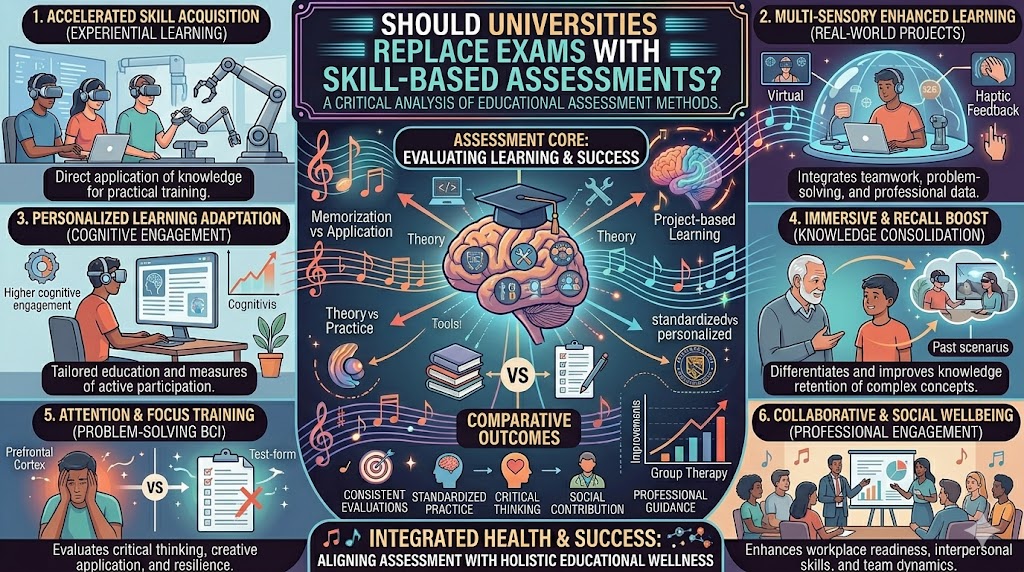
✨ Replacing exams entirely is not ideal, but relying only on exams is outdated. A blended system combining exams and skill-based assessments offers the most effective way to evaluate students and prepare them for real-world challenges.
The debate over whether universities should replace traditional exams with skill-based assessments is becoming one of the most important discussions in modern higher education. As industries evolve, employers increasingly demand practical skills, critical thinking, communication, and adaptability, rather than just theoretical knowledge or memorization. This raises a key question: are exams still the best way to measure student learning, or are they outdated in today’s skill-driven world?
📌 Understanding the Two Assessment Models
Before comparing them, it’s important to define both systems clearly.
- Traditional Exams: Timed, invigilated assessments that test memory, understanding, and problem-solving under pressure.
- Skill-Based Assessments: Evaluations based on real-world tasks such as projects, presentations, internships, case studies, portfolios, and practical demonstrations.


Both systems aim to measure learning—but they measure different dimensions of it.
🎯 Why Skill-Based Assessments Are Gaining Popularity
1. Focus on Real-World Skills
Skill-based learning prepares students for actual workplace demands. Instead of recalling formulas in an exam, students might:
- Design a project
- Solve real case studies
- Work in teams
- Present ideas professionally
This reflects what most jobs actually require.
2. Better Representation of Student Ability
Exams often test performance in a short time window. Skill-based methods evaluate:
- Consistency
- Creativity
- Practical problem-solving
- Communication skills
This gives a more complete picture of a student’s ability.
3. Reduces Rote Learning
One major criticism of exams is that they encourage memorization over understanding. Research in higher education shows that high-stakes exams often lead to surface-level learning rather than deep comprehension.
Skill-based assessments shift focus from “What do you remember?” to “What can you do with what you know?”
📚 The Strengths of Traditional Exams
Despite criticism, exams still play an important role in universities.
1. Standardization and Fairness
Exams provide a uniform method of evaluation. Every student is assessed under the same conditions, making grading more consistent.
2. Efficiency for Large Groups
For universities with thousands of students, exams are practical and cost-effective compared to evaluating individual projects.
3. Testing Under Pressure
Certain fields—like medicine, engineering, and law—require quick thinking under time constraints. Exams simulate this pressure effectively.
4. Preventing Academic Dishonesty
Controlled exam environments can reduce plagiarism and outside assistance, though they do not eliminate cheating entirely.
⚖️ The Major Problems with Exams
1. Encourages Memorization Over Understanding
Many students study only to pass exams and quickly forget the material afterward. This reduces long-term learning value.
2. High Stress and Anxiety
Exams often create intense pressure, leading to:
- Sleep problems
- Anxiety
- Burnout
- Reduced performance
3. Limited Skill Measurement
Exams struggle to assess:
- Creativity
- Teamwork
- Communication
- Leadership
- Practical skills
These are essential in modern careers.
4. Lack of Real-World Relevance
In most jobs, people use resources, collaborate, and solve open-ended problems—not sit alone in a silent room solving timed questions.
🧠 Why Skill-Based Assessments Are Not Perfect Either
While skill-based methods sound ideal, they also come with challenges:
1. Subjectivity in Grading
Projects and presentations can be harder to grade consistently compared to written exams.
2. Risk of Unequal Effort
Group work may allow some students to contribute less but still receive the same marks.
3. Resource Intensive
Skill-based evaluation requires:
- More time
- More faculty involvement
- Better infrastructure
4. Difficulty in Standardization
Unlike exams, projects vary widely, making comparisons across students harder.
🔄 The Best Solution: A Hybrid Model
Most education experts suggest that the best approach is not replacing exams completely—but combining both systems.
A balanced model may include:
- 📘 40%–60% exams for theoretical understanding
- 🛠️ Projects for applied learning
- 🎤 Presentations for communication skills
- 🧪 Practical labs for technical subjects
- 📁 Portfolios for long-term skill tracking


This combination ensures:
- Knowledge testing (exams)
- Skill development (projects)
- Real-world readiness (practical work)
🌍 What Employers Actually Want
Modern employers increasingly value:
- Problem-solving ability
- Communication skills
- Adaptability
- Teamwork
- Digital literacy
Interestingly, many of these cannot be fully measured by traditional exams. This is one reason universities are shifting toward skill-based education models globally.
However, employers still expect graduates to have strong foundational knowledge—which exams help reinforce.
🚀 The Future of University Assessment
The future is likely to be shaped by:
- AI-assisted grading systems
- Project-based learning environments
- Virtual simulations
- Continuous assessment instead of final exams
- Digital portfolios replacing single final tests
Some universities are already experimenting with program-based assessment, where multiple small evaluations replace one final exam.
📌 Conclusion
So, should universities replace exams with skill-based assessments?
The answer is not completely—but they should significantly reduce dependence on exams.
- Exams are good for testing knowledge and speed under pressure
- Skill-based assessments are better for real-world readiness and creativity
A modern university system should not choose one over the other—it should integrate both to produce graduates who are knowledgeable, skilled, and industry-ready.
The future of education is not exam-based or skill-based alone—it is competency-based learning that values both understanding and application.