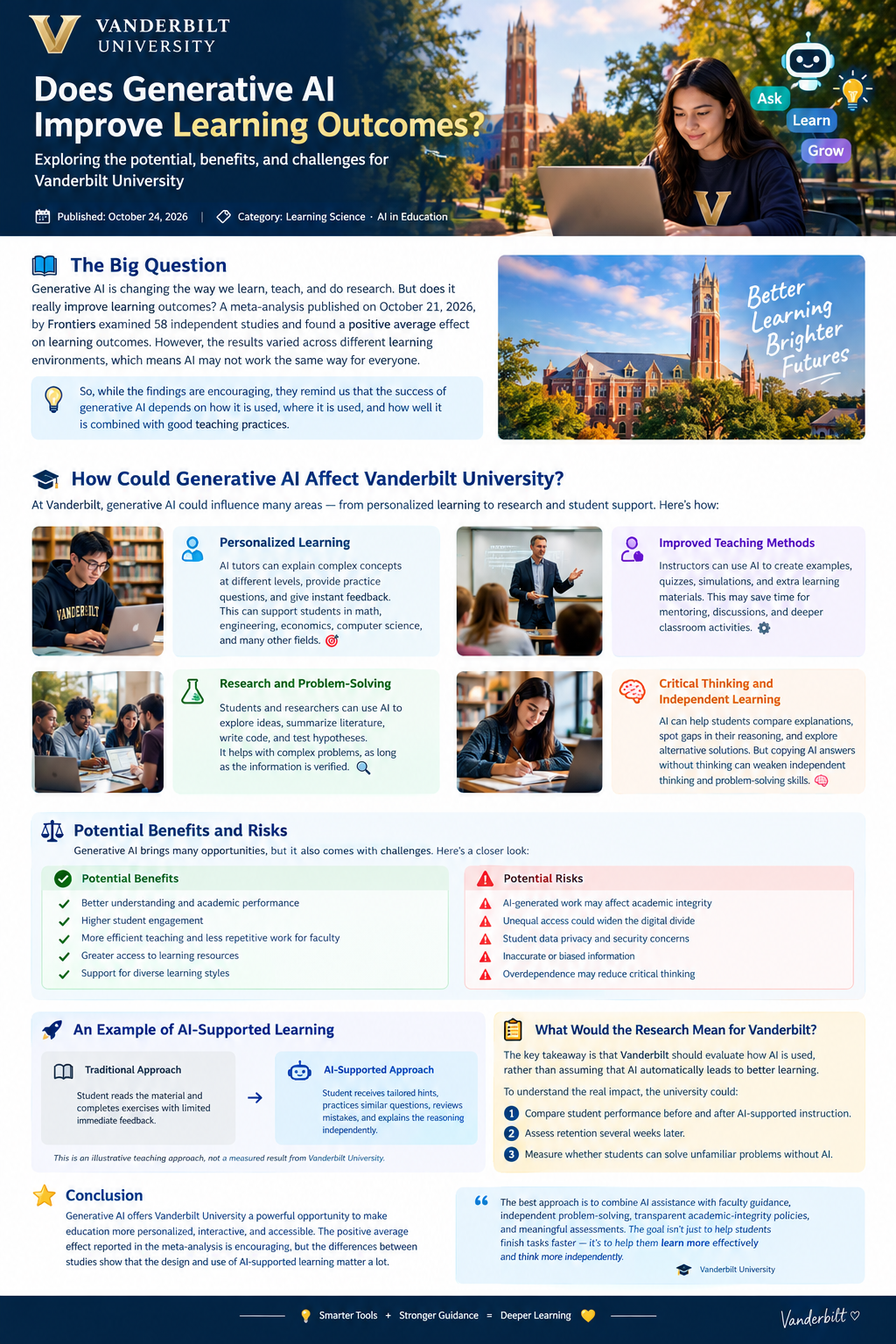
Generative AI could significantly influence teaching, learning, research, and student support at Vanderbilt University. The key question is not simply whether AI helps students learn, but how Vanderbilt can use AI to improve understanding, critical thinking, academic performance, and personalized learning without encouraging overdependence on technology.
The meta-analysis you mentioned, reportedly published by Frontiers on October 21, 2026, examined 58 independent studies and found a positive average effect on learning outcomes. However, because results varied across learning environments, the findings should not be interpreted as proof that every AI tool or teaching method improves learning equally.
How could generative AI affect Vanderbilt University?

Personalized learning
AI tutors could explain difficult concepts at different levels, generate practice questions, and give students immediate feedback. At Vanderbilt, this could support learning in mathematics, engineering, economics, computer science, and other subjects.

Improved teaching methods
Instructors could use AI to develop examples, quizzes, simulations, and supplementary learning materials. This may free up time for discussion, mentoring, and deeper classroom activities.

Research and problem-solving
Students and researchers could use AI to explore ideas, summarize literature, write code, and test hypotheses. These applications may help students engage with complex problems, provided they verify AI-generated information.

Critical thinking and independent learning
AI could help students compare explanations, identify gaps in their reasoning, and examine alternative solutions. However, copying AI answers without evaluating them could weaken independent reasoning and problem-solving skills.
Potential benefits and risks
| Area | Potential impact at Vanderbilt |
|---|---|
| Academic performance | Better explanations and additional practice may improve understanding. |
| Student engagement | Interactive tutoring could make difficult subjects more accessible. |
| Faculty workload | AI-assisted preparation may reduce some repetitive tasks. |
| Academic integrity | AI-generated assignments can make it harder to assess students’ own abilities. |
| Educational equity | Access to effective AI tools may help some students, but unequal access or AI literacy could widen gaps. |
| Privacy and accuracy | Student data, biased responses, and fabricated information require careful safeguards. |
What would the research mean for Vanderbilt?
The most important implication is that Vanderbilt should evaluate how AI is used, rather than assuming that AI use automatically leads to better learning.
For example, a student using AI to solve a calculus problem and submit the answer may learn less than a student who asks AI for hints, attempts the problem independently, and explains the solution in their own words.
An example of AI-supported learning
Traditional approach
Student reads the material and completes exercises with limited immediate feedback.
AI-supported approach
Student receives tailored hints, practices similar questions, reviews mistakes, and explains the reasoning independently.
This is an illustrative teaching approach, not a measured result from Vanderbilt University.
To determine whether these approaches work, Vanderbilt could compare student performance before and after AI-supported instruction, assess retention several weeks later, and measure whether students can solve unfamiliar problems without AI assistance.
Conclusion
Generative AI offers Vanderbilt University opportunities to make education more personalized, interactive, and accessible. The positive average effect reported in the meta-analysis is encouraging, but differences between studies suggest that the design of AI-supported learning matters considerably.
The strongest approach would combine AI assistance with faculty guidance, independent problem-solving, transparent academic-integrity policies, and assessments that measure genuine understanding. The ultimate goal should be to help students learn more effectively and think more independently, not simply complete academic tasks faster.
Research note: I could not independently verify the specific October 21, 2026, Frontiers meta-analysis from the available search results. The study details above are therefore treated as information supplied in your prompt, not independently confirmed findings.